







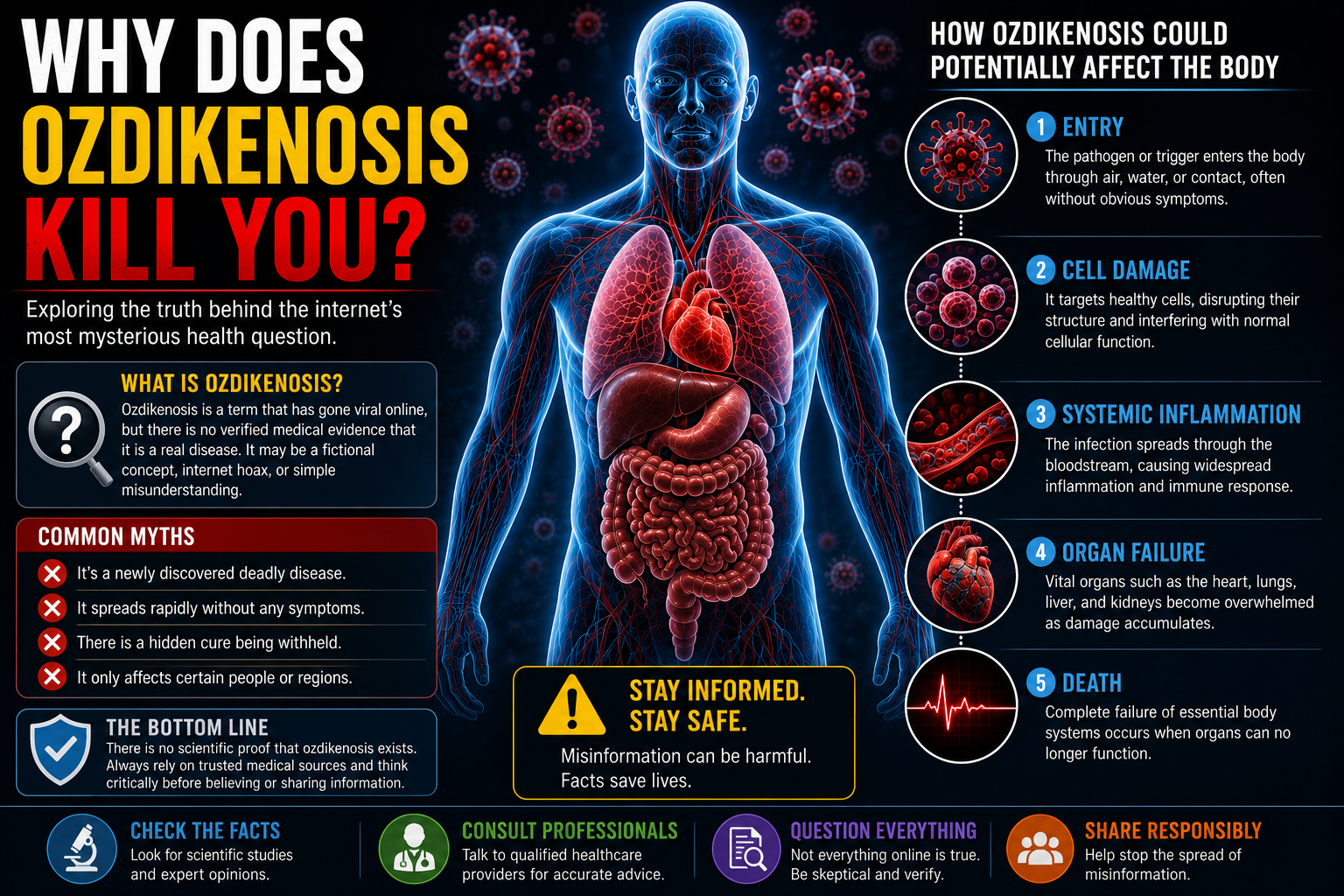
The internet has a unique way of turning obscure phrases into widely discussed topics. Sometimes these phrases relate to real-world events, while other times they emerge from rumors, fiction, or misunderstandings. One question that has recently attracted attention is why does ozdikenosis kill you. The wording sounds serious, scientific, and potentially alarming, which naturally encourages people to search for answers.
When people first encounter the term ozdikenosis, they often assume it refers to a dangerous disease. The name resembles legitimate medical terminology, and the question itself implies a fatal outcome. However, once individuals begin researching the topic, they quickly discover that reliable information is difficult to find.
This lack of clarity has made ozdikenosis an intriguing internet mystery. Understanding why people are interested in why does ozdikenosis kill you requires a closer look at how medical information spreads online, how misconceptions develop, and why mysterious topics continue to capture public attention.
The Appeal of Unexplained Health Topics
Health-related topics often generate strong emotional reactions because they are connected to personal well-being and survival.
When people see a phrase like why does ozdikenosis kill you, they immediately wonder whether it represents a genuine threat. Even if they have never heard of the condition before, the possibility of a serious illness motivates them to investigate.
Curiosity becomes even stronger when answers are difficult to find. The less information available, the more mysterious the topic appears.
This combination of uncertainty and perceived danger is one reason unusual medical-sounding terms often gain popularity online.
Why the Word Ozdikenosis Sounds Authentic
Language plays a powerful role in shaping perceptions. Scientific and medical terms often follow specific naming patterns that make them sound authoritative.
The word ozdikenosis resembles many real medical conditions because it includes a suffix commonly associated with diseases and biological processes. As a result, readers may assume it belongs to the same category as recognized medical disorders.
This resemblance is important when discussing why does ozdikenosis kill you because it explains why the term appears credible despite the lack of supporting evidence.
A scientific-sounding name can influence perceptions long before facts are examined.
What Medical Sources Reveal
One of the first steps in investigating why does ozdikenosis kill you is determining whether ozdikenosis exists within recognized medical literature.
Legitimate diseases are documented through scientific research, clinical studies, healthcare databases, and professional publications. These resources provide detailed information about symptoms, causes, diagnosis, and treatment.
Currently, there is no widely accepted evidence indicating that ozdikenosis is a recognized medical condition. Searches of mainstream healthcare resources do not reveal substantial documentation supporting its existence as a disease.
This absence of evidence suggests that claims about ozdikenosis should be approached with caution.
Possible Explanations for the Term
The lack of medical documentation raises an obvious question: where did the term originate?
One possibility is that ozdikenosis was created for fictional purposes. Writers frequently invent diseases for stories, games, films, and online narratives. These fictional conditions often sound realistic because they borrow elements from genuine medical terminology.
Another possibility is that the term developed through internet culture. Online communities sometimes create words that spread through social media, forums, and discussion platforms.
A third possibility is that ozdikenosis originated as a misspelling or altered version of another word. Similar examples have occurred many times online, leading to widespread confusion.
Regardless of its origin, there is currently no evidence confirming that it represents a medically recognized illness.
Why People Associate Unknown Conditions With Death
The question why does ozdikenosis kill you reflects a common psychological tendency. People often assume unfamiliar diseases are dangerous simply because they lack information about them.
Throughout history, new diseases have sometimes posed serious risks before they were fully understood. This historical reality influences how individuals react to unknown health-related terms today.
When information is missing, the human mind often fills the gap with assumptions. In many cases, those assumptions focus on worst-case scenarios.
This tendency explains why mysterious medical-sounding phrases frequently generate concern even when evidence is limited.
The Influence of Social Media
Social media platforms play a major role in shaping online discussions.
A phrase such as why does ozdikenosis kill you can gain visibility quickly if users share content that references it. Even a small number of posts can generate widespread curiosity when people begin asking questions.
Algorithms often prioritize content that generates engagement. Topics involving mystery, danger, or controversy tend to attract attention, making them more likely to appear in recommendations and trending discussions.
As a result, a little-known phrase can rapidly become a popular search term.
Understanding How Real Diseases Become Deadly
To evaluate claims associated with why does ozdikenosis kill you, it helps to understand how genuine diseases cause fatal outcomes.
Life-threatening illnesses generally interfere with essential bodily functions. They may damage organs, disrupt breathing, weaken the immune system, affect circulation, or impair neurological activity.
Scientists identify these mechanisms through clinical observation and rigorous research.
Because there is no verified medical evidence regarding ozdikenosis, there is no documented explanation describing how it would affect the body or whether it could actually be fatal.
Without scientific data, claims regarding mortality remain speculative.
The Difference Between Evidence and Assumption
One of the key lessons surrounding why does ozdikenosis kill you is the importance of distinguishing evidence from assumption.
Evidence consists of verifiable facts supported by research and observation. Assumptions are conclusions reached without sufficient proof.
The internet sometimes blurs the distinction between these categories. Repeated claims may appear convincing simply because they are repeated frequently.
However, repetition is not the same as verification.
Readers should always evaluate whether claims are supported by reliable sources before accepting them as true.
Why Internet Mysteries Continue to Fascinate People
Internet culture has a long history of embracing mysteries. Unexplained topics encourage investigation, discussion, and speculation.
Part of the fascination with why does ozdikenosis kill you comes from the absence of clear answers. People enjoy exploring puzzles and sharing theories about unresolved questions.
This curiosity is not necessarily negative. In many cases, it motivates people to learn more about science, medicine, and critical thinking.
The challenge arises when speculation is mistaken for fact.
Maintaining a distinction between the two is essential for accurate understanding.
The Importance of Reliable Health Information
Health information should always be approached responsibly.
When researching topics like why does ozdikenosis kill you, readers should prioritize credible sources such as healthcare organizations, medical journals, and licensed professionals.
Reliable information helps prevent unnecessary fear and reduces the spread of misinformation.
It also allows individuals to make informed decisions based on evidence rather than rumors.
In an age where information is available instantly, the ability to evaluate credibility has become increasingly important.
Lessons From Similar Online Trends
The story of ozdikenosis is not unique. The internet has repeatedly seen mysterious phrases become popular despite limited factual support.
In many cases, curiosity alone drives visibility. People search for answers because they want to understand what others are discussing.
The popularity of why does ozdikenosis kill you follows this pattern. Interest continues because the mystery remains unresolved.
This phenomenon demonstrates how online culture can transform obscure terms into widely recognized topics without requiring substantial evidence.
Critical Thinking as a Valuable Skill
Perhaps the most important lesson associated with why does ozdikenosis kill you is the value of critical thinking.
Critical thinking involves asking questions, evaluating sources, and seeking evidence before accepting claims.
When readers encounter unfamiliar information, they should consider where it originated, whether it is supported by research, and whether reliable experts recognize it.
These habits help prevent confusion and encourage a more accurate understanding of complex topics.
In a digital world filled with information, critical thinking remains one of the most effective tools for navigating uncertainty.
Conclusion
The question why does ozdikenosis kill you continues to attract attention because it combines mystery, science, and perceived danger in a single phrase. While the term sounds like the name of a serious medical condition, there is currently no widely recognized scientific evidence confirming that ozdikenosis exists as a documented disease.
Its popularity highlights the power of curiosity and the influence of internet culture. The mystery surrounding the term demonstrates how quickly unfamiliar concepts can gain visibility, even when reliable information is limited.
Ultimately, the discussion serves as a reminder that evidence matters. By approaching unusual claims with curiosity, skepticism, and a commitment to verification, readers can better separate fact from fiction and make informed decisions about the information they encounter online.